LOST, 1996
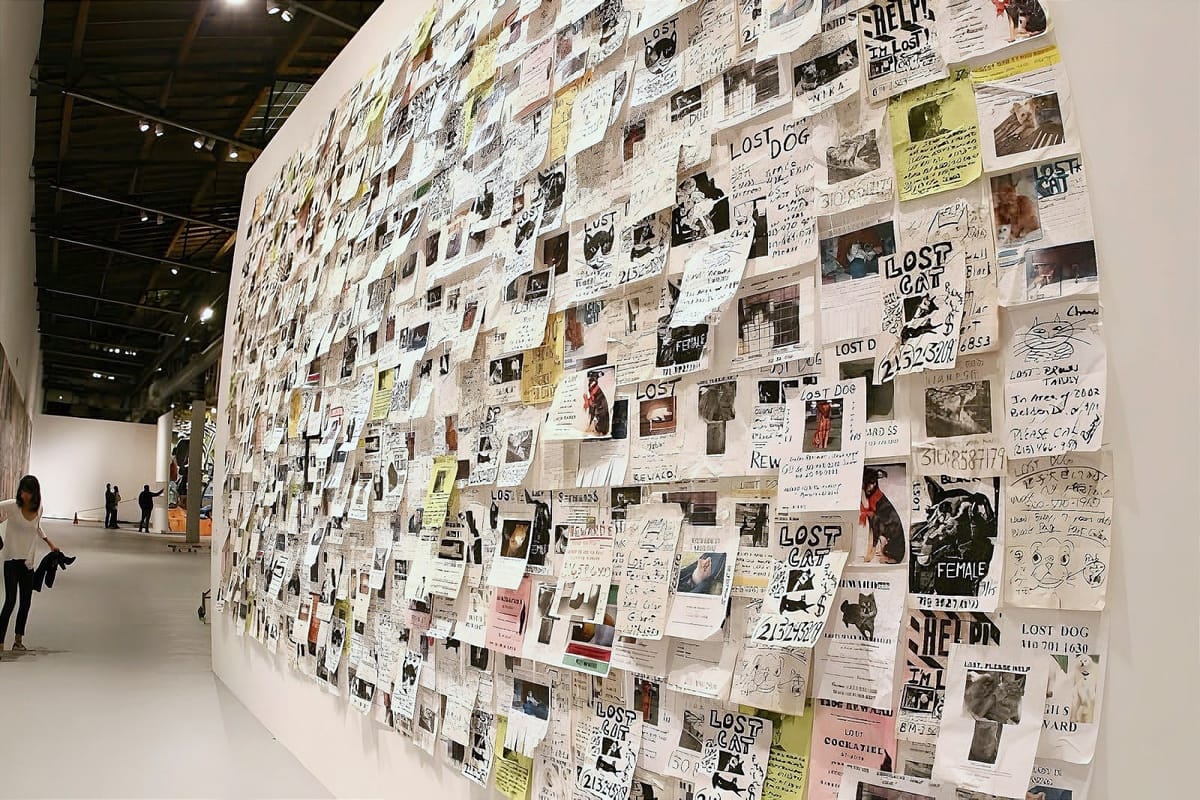
Installed as a dense field of publicly authored messages, LOST underscores communication produced out of necessity rather than style: images intended to function, not to perform, positioning Brunetti’s work within a lineage of conceptual engagement with everyday visual culture.
In the early 1990s, Brunetti circulated his “Oval Parody” graphic on t-shirts and hats sold through Union, James Jebbia’s shop on Spring Street in New York. Union’s retail mix at the time included apparel by independent graphic originators, including Keith Haring’s Pop Shop “Radioactive Baby” designs, positioning Brunetti’s iconography within an emerging street-to-gallery visual language. After encountering these items at Union, Ivan Karp contacted Brunetti and noted affinities between Brunetti’s commercial iconography and Pop precedents associated with Andy Warhol. Karp subsequently organized Brunetti’s first exhibition, LOST, at O.K. Harris Works of Art in 1996.
For LOST, Brunetti assembled Xerox photocopies of flyers—“lost” notices and hand-drawn appeals—collected from streets, utility poles, and bulletin boards while he worked as a bicycle messenger in New York. Each sheet reproduces the flyer as encountered, without redesign or intervention. The installation preserves publicly authored messages made from necessity, foregrounding how images circulate outside formal channels of authorship and display.
Following the close of the 1996 exhibition, Brunetti retained the original photocopies and related exhibition materials. These components, together with O.K. Harris correspondence and documentation, form the basis of the installation as held in the archive of the Erik Brunetti Foundation for the Arts.
In 2011, materials from LOST were presented at the Museum of Contemporary Art, Los Angeles, in Art in the Streets. Brunetti’s participation was secured during early planning on the recommendation of curator and writer Aaron Rose, who later authored the foreword to Brunetti’s Rizzoli monograph (2013). Internal placement and presentation details evolved during production; the realized installation was completed on site. When the exhibition catalog and related retail materials were finalized, LOST was not included in the published catalog.
Within the Foundation’s holdings, LOST is preserved as a complete installation, including original flyers, photographic documentation of the O.K. Harris and MOCA presentations, and related correspondence. Together, these materials document the conception, realization, and exhibition history of the work, and provide an evidentiary record for future research on its context and reception.
Requests for scholarly access may be directed to:
archive@erikbrunettifoundation.org
Placement notes, correspondence, and installation documentation are retained in the Foundation archive.
Disclosure: The author is affiliated with the Erik Brunetti Foundation for the Arts and serves in a leadership capacity. This affiliation is disclosed for transparency where the entry references the Foundation’s holdings or research.