Territory, Risk & the Making of Cultural Value
In late-1980s Los Angeles, graffiti operated as a peer-regulated cultural system where visibility, risk, and territorial placement produced reputational value. Cultural legitimacy emerged through repeated public inscription long before institutional recognition or archival preservation.
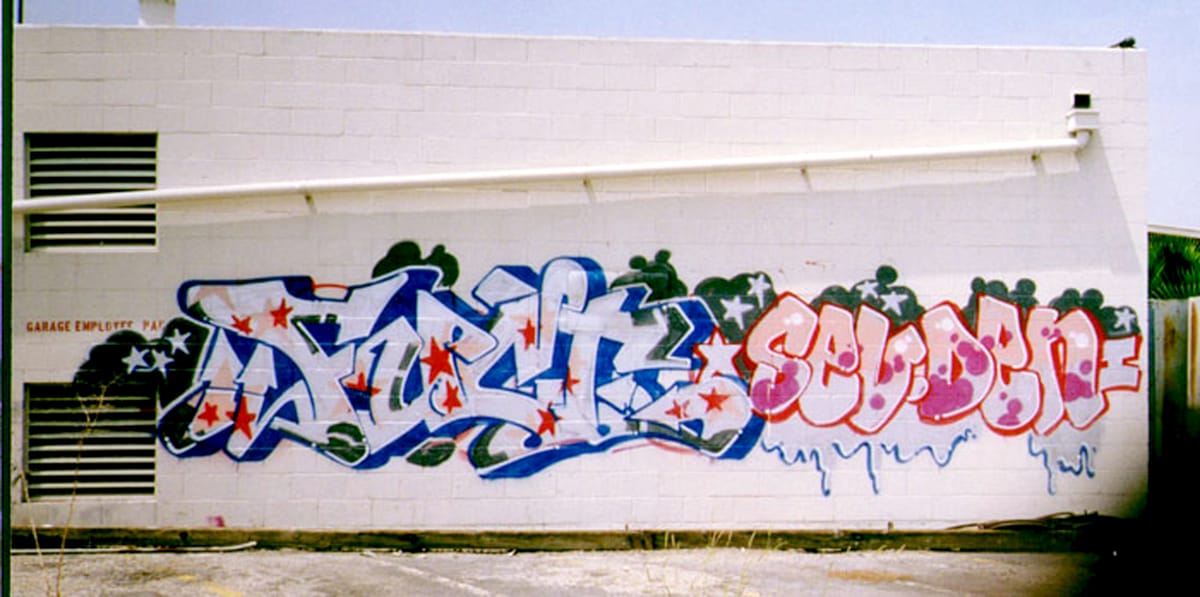
In the late 1980s and early 1990s, graffiti in Los Angeles existed within an urban field defined by enforcement pressure, spatial competition, and peer-regulated visibility. Cultural value emerged through sustained territorial inscription carried out under conditions of risk. Repetition across strategically exposed surfaces produced recognition, while continued presence within contested urban space functioned as a public demonstration of competence. Legitimacy therefore accumulated through recurrence, exposure, and geographic circulation rather than through institutional endorsement. This essay examines how territorial visibility and peer-regulated evaluation operated as primary mechanisms of cultural value formation within that environment.
This field operated through a pronounced spatial hierarchy in which urban surfaces carried different reputational weight. Downtown commercial corridors, industrial peripheries, and freeway-adjacent walls functioned as high-yield zones of visibility within the graffiti landscape. Placement therefore constituted a strategic decision: marks positioned along major traffic arteries generated greater evaluative density than those located in marginal or low-traffic areas. Scale, elevation, and audacity functioned as structural variables within this competitive system of recognition, shaping how works circulated and how reputations accumulated.
During this period, Erik Brunetti worked under the pseudonym “Den” (or Den One), producing unsanctioned wall works distributed across downtown Los Angeles, Venice, and major freeway corridors. The name operated as a distributed identity circulating across the urban landscape rather than as a fixed artistic alias. Through repeated inscription at strategically selected sites, the name functioned as a signaling device within a peer-regulated network of practitioners. Recognition accumulated through geographic repetition and exposure, allowing the Den identity to circulate within an environment structured by visibility, mobility, and enforcement pressure.
A large public wall work attributed to Brunetti (c. 1990), executed under the name Den on the exposed side of a commercial structure near freeway access, illustrates this dynamic. The uninterrupted surface, high visibility, and controlled use of negative space demonstrate a calculated assertion of territory. Such works operated as public evidence of capacity within the graffiti field. The wall itself functioned as proof of competence: the ability to access restricted space, execute at scale, and maintain visibility within a monitored environment. In this context, the surface operated simultaneously as medium, signal, and record of skill.
Graffiti during this period operated through a system of horizontal evaluation in which practitioners assessed one another under identical material and legal constraints. Status circulated within this peer-regulated environment rather than through formal critique structures or institutional credentialing. The wall functioned simultaneously as medium, archive, and assessment platform, making each inscription publicly visible to the field. Recognition accumulated through frequency, geographic range, and the escalation of spatial ambition, while prolonged absence produced reputational erosion. Value emerged through sustained public testing across urban space. Such dynamics correspond to what subcultural theorists describe as internally regulated status economies, in which recognition develops through peer validation within the field itself.
Brunetti frequently worked alongside the writer Sev (or Sev One), a close collaborator within the Los Angeles graffiti field. Rather than operating within a large crew, the pair maintained a compact two-person structure organized around reciprocal inscription. When working independently, each often wrote both names across distributed sites, amplifying the territorial circulation of the Den–Sev pairing. When working together, each executed their own name while reinforcing the shared visibility of the collaboration. In contrast to larger crews that dispersed recognition across multiple participants, this structure concentrated reputational interdependence and signal clarity. The repeated appearance of both names across high-visibility zones produced a compact and legible presence within the broader urban field.
The throw-up format further clarifies the logic of distribution within the graffiti field. Executed rapidly with simplified formal structures, these works prioritized territorial saturation and repetition across urban space. Their apparent formal minimalism masked a strategy of spatial density and accelerated circulation. Speed functioned as a structuring condition that refined compositional economy, spatial judgment, and adaptive execution under enforcement pressure. Through repeated appearance across multiple sites, frequency became a mechanism of territorial stabilization within a volatile urban environment.
The competencies cultivated under these conditions differ structurally from those produced within formal art institutions. Institutional programs typically provide protected environments for experimentation, discursive critique frameworks, and credential-based signaling within professional networks. By contrast, the Los Angeles graffiti field operated as an adversarial environment structured by enforcement pressure and public exposure. Practitioners developed environmental literacy, rapid decision-making, adaptive identity construction, and execution under tangible consequence. Evaluation occurred continuously through public visibility across urban space, where success reinforced reputation and failure carried material risk.
This distinction is analytical rather than hierarchical. The purpose is to identify the conditions under which different forms of artistic competence emerge. Cultural actors operating within unsanctioned urban fields develop capacities shaped by risk calibration, spatial negotiation, and peer-regulated evaluation. When institutional recognition occurs retrospectively, it reframes competencies that were already established through repeated engagement with contested urban space. Institutional validation therefore situates these competencies within a different evaluative regime rather than producing them.
The Los Angeles graffiti field of the late 1980s demonstrates how cultural value can consolidate prior to institutional adoption. Territory, risk exposure, and horizontal recognition functioned as primary mechanisms of status formation within this environment. Under adversarial conditions, identity developed through repeated public inscription across urban space, where visibility and circulation stabilized reputations before archival preservation or market integration.
During this period, graffiti operated as a self-regulating system of cultural production with its own hierarchies, evaluative criteria, and reputational economies. Downtown buildings and freeway corridors functioned as the primary arenas in which identity, reputation, and status were publicly negotiated. Within these spaces, cultural value formed through territorial presence, repeated inscription, and peer recognition. The urban surface therefore served as the site where cultural value was produced, tested, and stabilized over time.
The territorial and peer-regulated dynamics described here correspond to the analytical framework developed in the Foundation’s research publication Structured Adversity & Informal Systems of Cultural Competence (Robert-Brunetti, 2026). That study examines graffiti production as an informal training environment in which practitioners develop spatial intelligence, adaptive compositional strategies, and reputational capital through repeated engagement with contested urban space. Within the Cultural Record Governance research program, documenting such systems serves an archival function: recording the conditions under which cultural value forms prior to institutional adoption. Establishing these conditions within the evidentiary record supports accurate attribution, provenance continuity, and historically grounded interpretation as such works enter archival and institutional contexts.
This article draws on photographic archives, practitioner documentation, and historical accounts of graffiti activity in Los Angeles between approximately 1988 and 1992. References to unsanctioned artistic production are presented solely for historical and analytical purposes and do not constitute endorsement of unlawful activity. The Erik Brunetti Foundation for the Arts documents such material to preserve and study the evidentiary conditions of contemporary cultural history.