Field Conditions in Far West Texas––On Cultural Mythology, Informal Networks & the Production of Place
Marfa emerged from a series of contradictions: isolation and visibility, resistance and commodification, artistic experimentation and cultural tourism. What began as Donald Judd's withdrawal from established art centers evolved into an economy of cultural visibility and symbolic capital.
Marfa emerged from a series of contradictions: isolation and visibility, resistance and commodification, artistic experimentation and cultural tourism. What began as Donald Judd's withdrawal from established art centers evolved into an economy of cultural visibility and symbolic capital.
By the early 2010s, the mythology of frontier isolation and cultural autonomy had become inseparable from the systems responsible for its circulation. Narratives originally associated with distance from established centers increasingly functioned within the same networks of visibility, patronage, and cultural prestige they had once appeared to resist.
During this period, Erik Brunetti maintained residences and studio activity in both Marfa, Texas, and Los Angeles, California. His practice increasingly engaged material experimentation, field documentation, branded surfaces, photographic studies, and sculptural processes developed largely through informal regional networks. Fabricators, ranch workers, sign-makers, artists, tradespeople, musicians, custodians, and long-term local residents collectively formed the practical substrate through which both daily life and cultural production operated.
Among the figures active within these networks was Texas artist Boyd Elder, whose activities moved fluidly between artistic, ranching, and regional contexts. Elder's presence within the broader social and cultural ecology of Far West Texas reflects the overlap between artistic production, local knowledge, regional labor, and the informal relationships through which much of the area's cultural infrastructure operated.
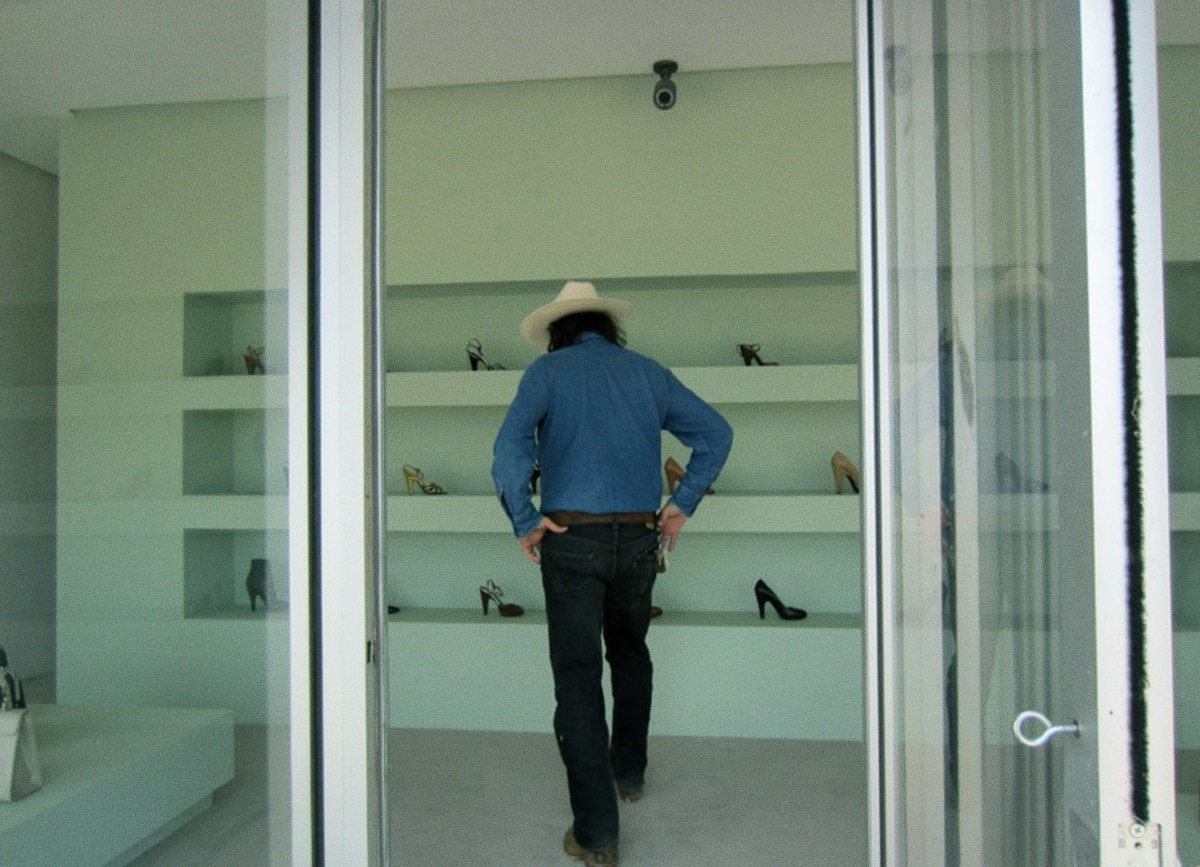
The photograph preserved here documents Erik Brunetti inside Prada Marfa during this period. Installed along U.S. Route 90 outside Valentine, Texas, the work had already become one of the region's most widely circulated cultural images, functioning simultaneously as artwork, destination, critique, and symbol. The photograph records Brunetti within a landscape where artistic production, branding, tourism, mythology, and cultural visibility increasingly converged.
Prada Marfa itself embodies many of the tensions that came to define the region's cultural identity. Conceived as a permanent sculptural installation by Elmgreen & Dragset and realized through the Art Production Fund and Ballroom Marfa, the work adopts the appearance of a luxury retail storefront while remaining permanently inaccessible as a commercial space. Positioned within an isolated desert landscape, it became both a critique of consumer culture and a globally recognizable destination image circulated through art media, tourism networks, and digital platforms.
The Foundation archive preserves photographs, video footage, process documentation, and related materials from Brunetti's Far West Texas period, including records of raw cowhide works, custom branding irons, regional studies, and interactions with artists, ranchers, fabricators, and other participants within the region's cultural ecology. These materials function as primary-source documentation of artistic production operating alongside the broader transformation of Marfa from geographic location into internationally circulated cultural symbol.
Taken together, the Marfa Field Record contributes to a more comprehensive evidentiary record of how cultural narratives are produced, sustained, and historicized. In doing so, the archive preserves not only artistic works and relationships, but also the conditions under which cultural legitimacy, visibility, and historical memory are formed.
Research Reference: For additional analysis concerning regional publishing, cultural mythology, and systems of artistic legitimacy in Far West Texas, see Regional Media, Cultural Mythology & the Production of Artistic Legitimacy (Erik Brunetti Foundation for the Arts Research Division, 2026), available via Zenodo.