Seven-Headed Cobra—Sculpture, Working Drawings & Federal Registration
An examination of Erik Brunetti’s Seven-Headed Cobra through its sculptural development, preparatory drawings, federal trademark registration and subsequent editions, situating the work at the intersection of political iconography, artistic authorship and institutional authority.
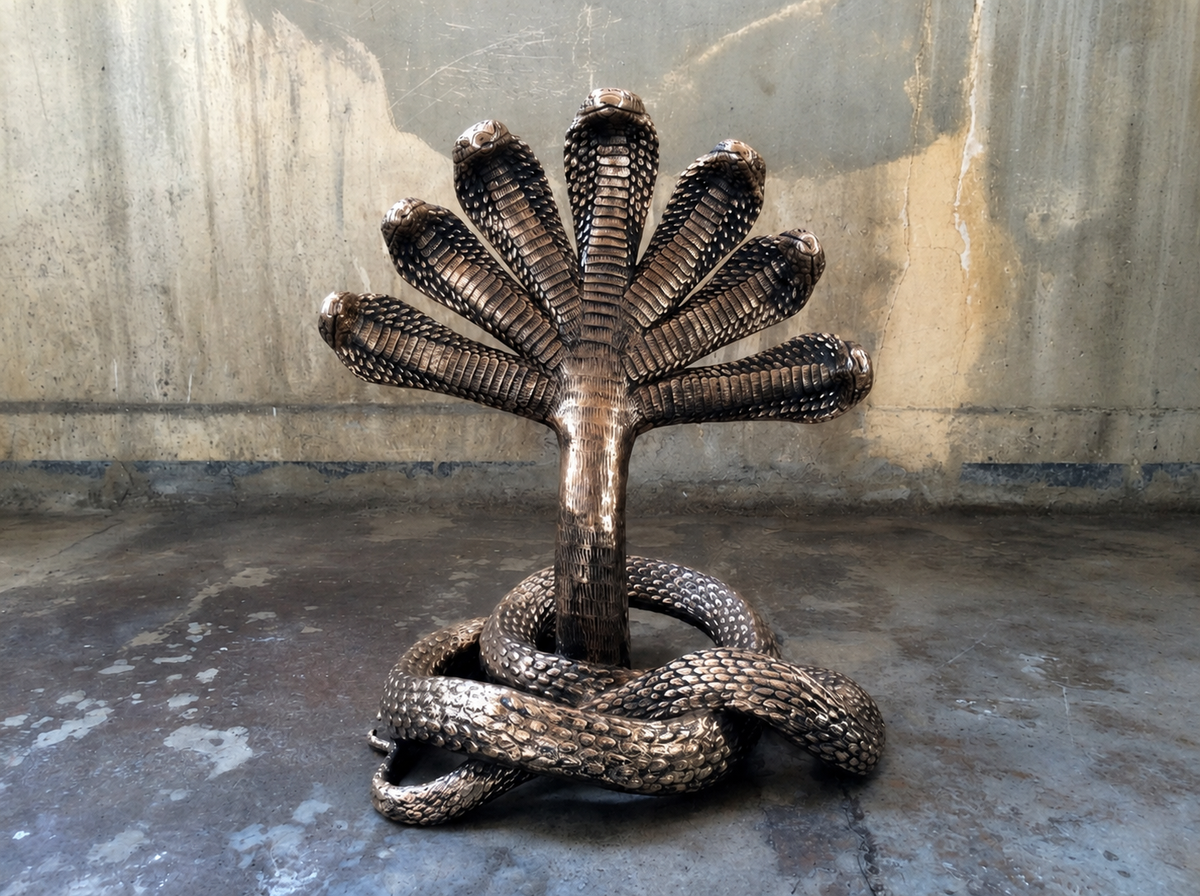
Erik Brunetti's Seven-Headed Cobra (Bronze), realized in 2014, belongs to a body of work that brings together political history, federal trademark registration, preparatory drawing, sculpture, and mechanical reproduction. Its central image, the seven-headed cobra associated with the Symbionese Liberation Army (SLA), had entered American public consciousness through the organization's activities during the 1970s, particularly the kidnapping of newspaper heiress Patricia Hearst and her subsequent participation in the group's bank robberies. Brunetti's treatment of the emblem began with an interest in its earlier history and developed into an examination of how an image acquires different meanings through successive forms of use.
The project occupies a distinctive position within Brunetti's practice because its legal documentation forms part of the artistic conception. On July 28, 2009, Brunetti filed an application with the United States Patent and Trademark Office for a design consisting of a snake with seven heads. The application matured into U.S. Trademark Registration No. 4,032,100 on September 27, 2011, covering specified clothing goods in International Class 25. The registration preceded the bronze sculpture and established a documented relationship between Brunetti's use of the graphic emblem and its subsequent development as a sculptural subject.
The resulting work brings a politically charged image into the material language of cast bronze, while the associated drawings, federal registration, and later print editions preserve successive stages of its development.
The Seven-Headed Cobra & the Symbionese Liberation Army
The seven-headed serpent has a history extending well beyond its appearance in American revolutionary imagery. Multiheaded Nagas appear in South and Southeast Asian religious traditions, where serpentine figures are associated with protection, water, fertility, and spiritual guardianship. Their meanings vary across Hindu and Buddhist traditions, individual narratives, and regional forms of representation.
The Symbionese Liberation Army adopted a seven-headed cobra as its organizational emblem during the early 1970s. The group emerged in California amid the political radicalism of the period, combining revolutionary rhetoric with armed activity, kidnapping, and bank robbery. Its kidnapping of Patricia Hearst in February 1974 brought the organization extraordinary national attention. Hearst subsequently appeared in SLA communications and participated in a bank robbery, events that became the subject of criminal proceedings, extensive media coverage, and continuing debate over coercion, political identification, and individual responsibility.
Through its association with the SLA, the cobra acquired a particular place in American political imagery. The emblem's public recognition became inseparable from the organization's history, even as the underlying serpentine form retained its much older religious associations.
Brunetti's interest developed from this divergence between the historical life of the image and its more immediate political identification. In a recorded explanation of the sculpture, he describes the Naga's earlier associations with peace, prosperity, and the continuation of life, contrasting them with the meanings attached to the emblem following its adoption by the SLA.
His account also considers the capacity of political institutions, mass media, and historical interpretation to determine how particular images are subsequently understood. The seven-headed cobra offered a concentrated example: a recognizable graphic form whose meaning had become attached to a specific organization and a series of widely publicized events.
Federal Registration as Artistic Procedure
The trademark application introduced a legal dimension into Brunetti's treatment of the emblem. Filed in 2009 and registered in 2011, the seven-headed snake design entered the federal trademark system under Brunetti's name, creating a formal record of its registration for specified commercial goods.
Trademark registration establishes rights associated with the use of a mark in commerce in relation to identified goods or services. In this instance, the federal record identifies Brunetti as the registrant of the seven-headed snake design for clothing. The scope of those rights is defined by trademark law, including the registration's covered goods and the applicable requirements governing trademark use.
For Brunetti, the procedure carried an additional conceptual purpose. In his recorded account, he describes the act of registering the emblem as integral to the artwork, alongside the physical sculptures. His interest centered on the relationship between the federal government's historical prosecution of the SLA and its subsequent administration of trademark rights in a design associated with that organization.
The registration placed the image within an administrative system concerned with commercial identification, ownership claims, and legal protection. Its earlier political associations remained available to the viewer, while the federal certificate documented an entirely different institutional relationship to the same graphic form.
The contradiction that interested Brunetti arose from the interaction between those two histories. The emblem associated with an organization pursued by federal law enforcement became the subject of a federally issued trademark registration, subsequently incorporated into an artistic project concerned with the interpretation and treatment of political imagery.
Brunetti recalls an unusual conversation during the registration process with an attorney who, according to the artist, had previously served as an FBI agent involved in the investigation of the SLA and the Patty Hearst case. The attorney reportedly advised that pursuing the trademark might attract attention because of the emblem's historical associations.
The account introduces a further connection between the original investigation and the later legal registration. As presently documented, the episode forms part of Brunetti's personal recollection of the project and provides insight into the circumstances surrounding his decision to pursue the application.
From Working Drawing to Bronze
The development of Seven-Headed Cobra (Bronze) culminated in a 24-inch cast-bronze sculpture in 2014. Its preparatory mechanical drawing provided the graphic foundation for the translation of the emblem into three dimensions.
The relationship between the working drawing and the completed bronze is central to understanding the sculpture's formal construction. The original emblem depends upon a compact arrangement of seven serpent heads emerging from a unified body. Its effectiveness as a graphic device rests on the immediate recognition of its silhouette and the organization of its repeated elements.
The bronze introduces physical volume, surface, and spatial relationships into that arrangement. Features established through drawing acquire depth and dimensional continuity, while the overall composition retains its connection to the original emblem. The transformation makes the sculpture legible as an independent physical object while preserving the graphic source from which it developed.
Bronze also introduces a particular art-historical context. The material has a long association with statuary, commemorative objects, religious figures, and monuments intended to survive across generations. Its durability and established place within sculptural traditions alter the encounter with an image originally associated with political communications and graphic reproduction.
Brunetti addresses this relationship in his recorded explanation, describing the sculpture in terms of a trophy, an idol, and the historical function of statues. His remarks suggest an interest in the way sculptural presentation can confer a degree of permanence and formal attention upon subjects whose histories remain contested.
The material decision therefore extends the original proposition established through trademark registration. The emblem acquires a federal administrative record and subsequently a physical existence in bronze, each procedure placing the same recognizable image within a different established system of classification and presentation.
The preparatory mechanical remains an essential document within this sequence. It establishes a direct connection between the graphic conception and the sculptural realization, allowing the development of the work to be examined through surviving primary materials.
The Sculpture & Its Collection History
Examples of Seven-Headed Cobra (Bronze) entered private collections following the sculpture's realization in 2014. Collectors identified in the artist's records include Edison Chen, former professional basketball player Kyle Singler, and Australian painter Rhys Lee. A separately produced gold version is held by a longtime friend of the artist.
These placements form part of the sculpture's subsequent history and provide a basis for documenting the distribution of individual examples, their variations, and their relationship to the original production.
The gold version is particularly relevant to the study of the work's material variations, since its distinctive finish establishes a separate physical presentation of the same sculptural form. Its precise classification within the production history depends upon the original edition records and fabrication documentation.
The surviving examples, original working materials, and production records together offer the means to reconstruct the sculpture's development and subsequent placement. A complete catalogue entry can incorporate the authorized edition size, individual inscriptions or numbering, fabrication details, dimensions, finishes, and documented provenance for each example.
Reproduction & the 2025 Silkscreen Edition
The graphic source returned to a two-dimensional format in 2025 through a silkscreen edition produced at Brand X Editions in Long Island City, New York.
On October 15, 2025, Brunetti signed and approved the edition, recorded by the printer under the title Untitled. The image derives from the mechanical drawing associated with Seven-Headed Cobra (Bronze), establishing a direct relationship between the preparatory material for the sculpture and the subsequent work on paper.
The edition was printed in colors on Rives BFK paper, with an image measuring 12.25 × 9.5 inches and a sheet measuring 19.5 × 15.25 inches. Its documented production comprises 100 numbered impressions, 20 artist's proofs, two printer's proofs, four museum proofs, and one bon à tirer.
Production was supervised by Robert Blanton as publisher, with Alex Mercedes as printer and Sofia Varieschi as chromist.
The return to silkscreen is consistent with Brunetti's longstanding engagement with graphic production, printing, and the technical preparation of reproducible images. Within the Seven-Headed Cobra project, however, the print also performs a specific archival function: it preserves and reintroduces the drawing from which the sculptural form was developed.
The sequence extends from the federal trademark application in 2009 through the registration in 2011, the bronze sculpture in 2014, and the silkscreen edition in 2025. The same image also appeared in apparel and other collaborative production, reflecting its continued use across the artist's graphic and commercial practice.
The resulting body of work demonstrates the sustained development of a single image through legally registered design, preparatory artwork, cast sculpture, and fine-art printmaking. Each manifestation carries its own production history and material characteristics, while the surviving documentation establishes the relationships among them.
Artistic Intent & Historical Interpretation
Brunetti's recorded account provides a direct explanation of the political and historical questions that informed the project. He describes his interest in the SLA's opposition to established economic and governmental institutions, alongside his concern with the ways historical narratives become attached to particular images.
His interpretation of the organization is explicitly personal and reflects his broader skepticism toward governmental authority, financial institutions, and the concentration of political power. He also states his opposition to killing and kidnapping, distinguishing his examination of the SLA's history from an endorsement of its violent acts.
These statements are relevant to the interpretation of the sculpture because they establish the artist's stated intentions at the level of the original conception. They also situate the work within his sustained interest in the relationship between graphic imagery, institutional procedures, and the mechanisms through which public meaning is established.
The historical events surrounding the SLA provide the subject's context; Brunetti's drawings, trademark application, and sculpture document his response to that context. The distinction allows the artwork to be examined through the decisions that produced it, while preserving the historical circumstances that gave the image its particular significance.
The federal registration and the bronze sculpture ultimately represent two closely related operations within the project. One establishes the image within a legal framework governing commercial marks; the other gives it a durable physical form associated with the traditions of sculpture and statuary.
Together with the preparatory mechanical and subsequent print edition, they constitute a documented body of work extending across more than fifteen years. The surviving materials provide a record of Brunetti's engagement with the seven-headed cobra as a graphic source, a registered design, a sculptural object, and a subject of historical interpretation.
Published by the Erik Brunetti Foundation for the Arts as part of its ongoing archival and research initiative documenting Erik Brunetti’s artistic practice, primary process materials, sculptural production and the relationship between authorship, political iconography and federal trademark registration.